
532 AD The Nika Riots
The Nika Riots of 532 AD were the deadliest urban revolt in the history of Constantinople, the capital of the Byzantine (Eastern Roman) Empire. What began as a dispute over chariot racing factions quickly escalated into a full-scale rebellion that nearly toppled Emperor Justinian I.
Sporting Rivalry: The city was divided into four chariot-racing factions, primarily the Blues and the Greens. These groups functioned like a mix of modern sports fans, street gangs, and political parties.
The Botched Execution: In 531 AD, members of both factions were arrested for murder following a previous riot. During the execution, two men (one Blue and one Green) survived when the scaffold broke and fled to a church for sanctuary.
Political Discontent: Beyond the execution, the public was enraged by Justinian’s heavy taxation and the corruption of his officials, specifically John the Cappadocian and Tribonian.
The Unified Shout: On January 13, 532, at the Hippodrome, the rival Blues and Greens united for the first time, shouting “Nika!” (Greek for “Victory!” or “Conquer!”) as a battle cry against the Emperor.
Chariot-Racing Hooliganism? The Nika Riots of Constantinople
Constantinople’s Nika Riots of 532 may seem like a dark precursor to the so-called Dark Ages of the early medieval period. A tempting assumption to make is that a bout of collective madness and lack of societal restraint caused the grumbles of chariot-racing fans to escalate to the point of laying waste to large parts of the city and thousands dying. Sixth-century Constantinople was far from a place of anarchy, however. It was one of the most sophisticated cities on the planet, with a social order underpinned by a vast legal code. The Nika Riots were, in fact, more ofa sudden social implosion fuelled by mismanagement from an earnest emperor trying to do his best but failing disastrously.
Reevaluating the Nika Riot & Placing it in Conversation with the Antioch Riot of 387
You enter into the stadium and find a place to sit down, doing chores around the house
made you late, but multiple races run each day, so much of the fun is still ahead. Behind you sits
a man, having brought his son to see the games. In front of you is a young man and woman
talking about their interests, on their first date no doubt. You strike up a conversation with the
man sitting to your left and begin to talk about the new taxes you both have to pay. Your
conversation draws to a close as you hear a horn and your attention is drawn below. Moments
before the racers had lined up, but now they have become a loose mob, with one clearly leading
the rest. He whips his horses on, making sure to stay on the inside track, but other are close
behind him. He slows down at the turn, but a competitor whips up his chariot trying to get ahead.
For the moment he seems in the lead, but his speed in the turn drives him off course, causing
both horses and the two riders to crash. You hear the man to your right curse his luck, having lost
yet another bet as he hands some coins to his beaming friend. In the other section you hear taunts
and jeers from the rival team, the Blues.
The Nika Riot
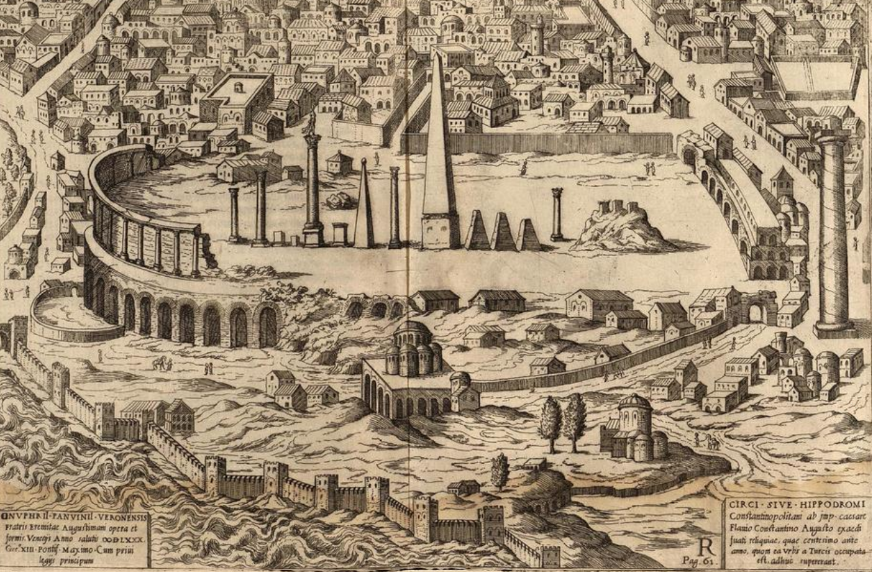
In the fifth century AD, as the expense of festivals and spectacles increased, the circus factions began to take responsibility, not only for the races, but for other kinds of entertainment, including pantomimes and wild beast fights. The Blues and Greens came to predominate and, although this arrangement made organization easier, it also focused loyalty on these two factions alone, the Blues sitting opposite the imperial box (kathisma) near the starting gates of the Hippodrome and the Greens at the other end near the sphendone, a juxtaposition that no doubt contributed to a rivalry already made intense by the support of Justinian for the Blues. It was in the Hippodrome at Constantinople, as in the Circus at Rome, that the populace could express itself to the emperor and expect a response. And it was in the Hippodrome that partisans acted out when their faction was defeated, as when Porphyrius the charioteer won at Antioch in AD 507.
Spectacle and Sport in Constantinople in the Sixth Century CE
This chapter talks about the critical social role of spectacle and sport in the Byzantine world. In typical Byzantine fashion, sport and spectacle were bureaucratized in the late fifth century. The importance of chariot racing in the Byzantine world is evident from the central position of the hippodrome in the capital, Constantinople. Of all the impacts of sport and spectacle in the Byzantine world of the sixth century, riots are perhaps the most frequently cited. The final decline of the spectacle of chariot racing in the Byzantine world may be traced to a gradual change of tastes in the High Medieval period. By this time the exuberant faction riots of the sixth century had long since faded away, but for a time in their heyday they had provided an important outlet, not just for economic, political, or religious pressures, but also for the passion for spectacle and sport.
Blue versus Green: Rocking the Byzantine Empire
A deep dive into how these factions rocked the empire and the specific role of Monophysitism.
The Chronicle of John Malalas (Books 8–18)
Malalas lived in Antioch and is the most vital contemporary source for these events. This translation covers the reign of Anastasius I (Book 16).
Malalas, Chronography Bks 1-7, 10-18
An indexed, searchable version of Malalas’ work for navigating specific years and locations.
We Will Curse You
A history of sports fans resorting to performance-enhancing curses, from the Nika riots to the Red Sox.