

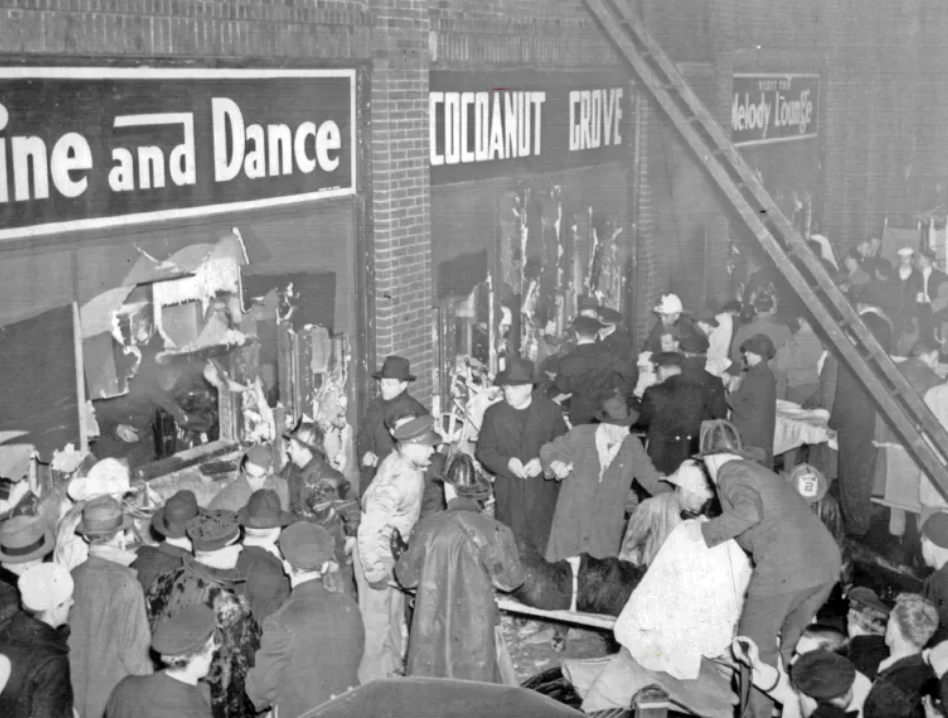
Cocoanut Grove fire 28/11/1942
The Cocoanut Grove fire occurred at a nightclub in Boston, Massachusetts, on 28 November 1942 and resulted in the deaths of 492 individuals. It is recognised as the deadliest nightclub fire in recorded history and the third most fatal single-building fire in the United States, exceeded only by the September 11 attacks and the Iroquois Theatre fire. At the time, the Cocoanut Grove was regarded as one of Boston’s most fashionable and well-attended entertainment venues and was frequented by prominent public figures. Ownership of the establishment was held by Barnet “Barney” Welansky, whose associations extended to organised crime and senior municipal officials. Numerous fire safety regulations had been disregarded, including the locking of exit doors to control access and the installation of highly combustible decorative materials, such as artificial palm trees. Additionally, the air-conditioning system contained a flammable gas, a consequence of wartime shortages of non-flammable refrigerants, which significantly contributed to the rapid spread of the fire.
The Cocoanut Grove inferno
Flip through this,” said retired firefighter Charles Kenney of Harwich, handing over a document with 11 pages of names. “Force yourself to turn every page. It gives you an idea of what the Cocoanut Grove fire meant to Boston. Page after page of names, 492 of them, all dead. It’s hard to comprehend.” Few events have taken a greater toll on Boston’s psyche than the Cocoanut Grove fire 50 years ago next Saturday night. Hollywood rarely provides the drama of that 15-minute fire, rarely captures the horror and never conveys the agony endured by victims and their families for days, even years.
Tiny flame turned festive Cocoanut Grove into house of horror 25 years ago
News from the year
The Cocoanut Grove Fire
The Cocoanut Grove was a restaurant/supper club (nightclubs did not officially exist in Boston), built in 1927 and located at 17 Piedmont Street, near Park Square, in downtown Boston, Massachusetts. Piedmont Street was a narrow cobblestoned street (now paved) located near the Park Square theater district, running from Arlington Street to Broadway.
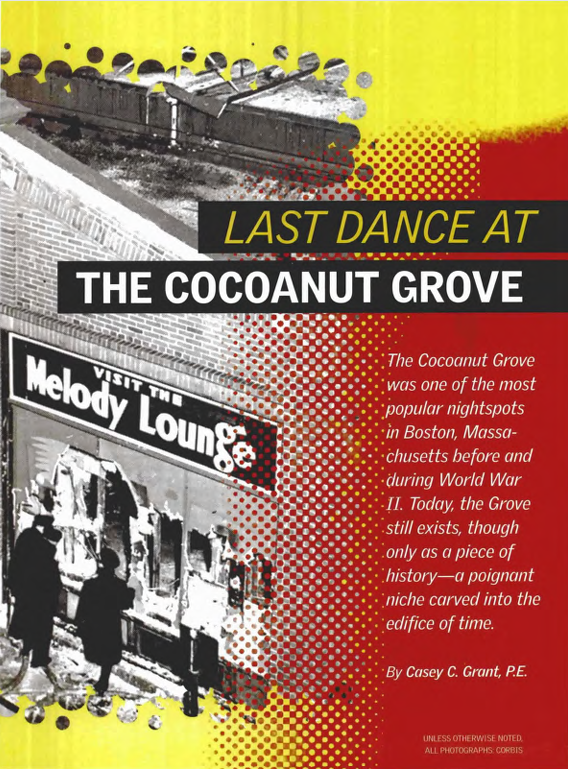
The Cocoanut Grove Revisited
U.S. Navy Records Document How 492 Died in a Deadly Nightclub Fire 75 Years Ago
83 years ago, the Cocoanut Grove nightclub fire changed safety codes and burn care
After more than 80 years, the Cocoanut Grove nightclub fire remains one of the nation’s deadliest. Many safety lessons came from the tragedy that claimed nearly 500 lives in Boston.
Triage in Medicine, Part I: Concept, History, and Types
HEALTH POLICY AND CLINICAL PRACTICEICONCEPTS
City, advocates break ground at new memorial 81 years after deadly Cocoanut Grove nightclub fire claimed nearly 500 lives
“The impacts of Cocoanut Grove are already forever enshrined in the regulations, safety practices, the innovations and knowledge that have already saved countless lives,” Boston Mayor Michelle Wu said.
The Cocoanut Grove Fire: Lessons from the Past
Members of the Shirley Parsons Boston office recently attended the Greater Boston ASSP and New England AIHA Technical Dinner Meeting in Waltham, MA, where they were among the first to view a recently completed documentary called “Six Locked Doors”.
The documentary was presented by producer, Paul Miller, and told the story of the Cocoanut Grove Fire, along with victims’ personal accounts and the legal and regulatory aftermath. Further research was conducted following the technical dinner; here’s what our team learned.
83 years after deadly Cocoanut Grove fire, descendants of those killed remember who they lost
The weekend after Thanksgiving in 1942, a teenage Ina Fay Cutler was glued to her radio. There was news of a terrible fire that broke out at a nightclub in Boston where her mother, Jeannette Zall had spent her evening.
The 1942 fire at Boston's Cocoanut Grove nightclub
Abstract
The year 1992 marked the 50th anniversary of one of the worst civilian disasters in American history. On November 28, 1942, fire destroyed Boston’s Cocoanut Grove nightclub, killing 491 people and sending hundreds more to area hospitals. The disaster came at a unique time in the history of burn care and resulted in a number of important advances in burn treatment, including the first comprehensive descriptions of inhalation injury, improvements in topical treatment of burn wounds, resuscitation of shock, use of antibiotics, and understanding of the metabolic response to injury. In addition, the fire stimulated organization of burn care facilities, public safety legislation, and burn prevention. The history of the fire is reviewed, emphasizing its role in stimulating advances that formed some of the foundations of modern burn treatment.