


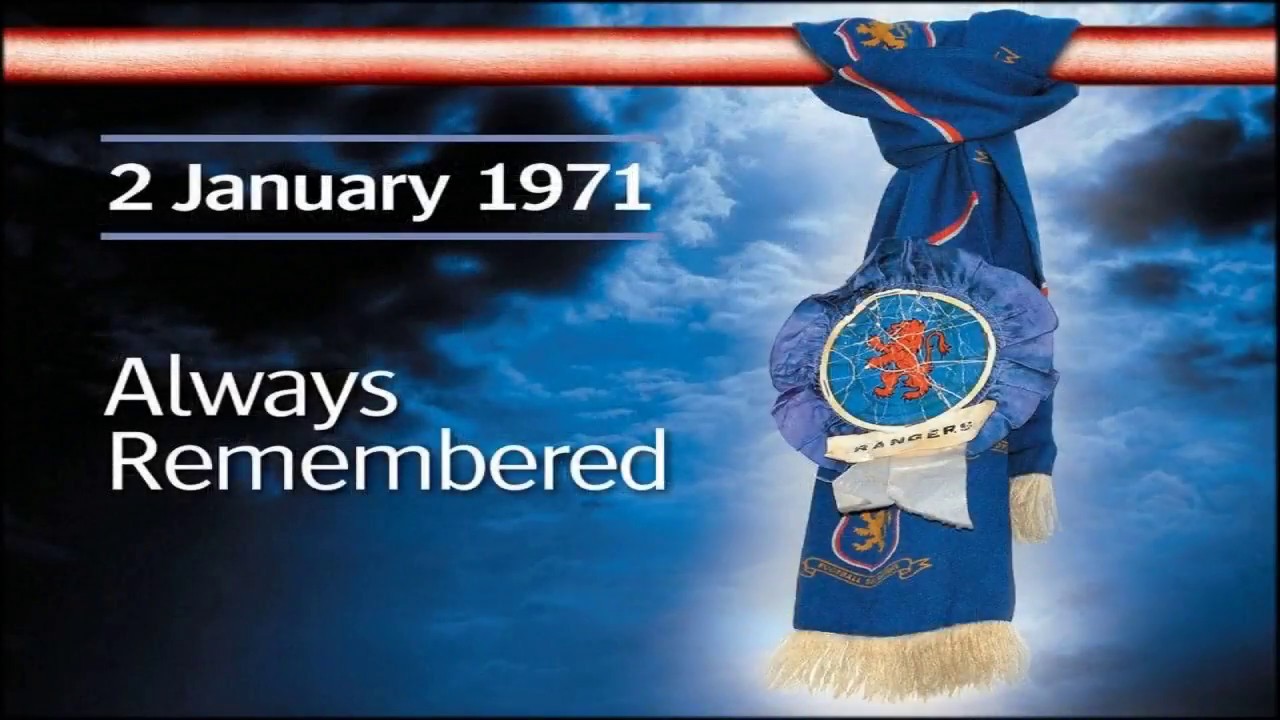
Never to be forgotten
In memory of the 66 supporters who lost their lives following the disaster at Ibrox Park on 2 January 1971.
Ibrox Disaster
On 2 January 1971, more than 80,000 spectators attended Ibrox Stadium in Glasgow for an Old Firm match between Rangers and Celtic. As the match ended and large numbers of supporters began leaving the ground, a catastrophic crowd failure developed on the north-east exit route known as Stairway 13. Sixty-six people died, predominantly from compressive asphyxia, and many more were injured. The Fatal Accident Inquiry subsequently concluded that one or two people fell on the staircase, followed by further falls and a severe accumulation and compression of people.
The disaster did not occur without a history. Earlier fatalities, crowd incidents, engineering works, safety inspections and correspondence relating to the stadium survive in the historical record. The Mitchell Library's extensive Ibrox Disaster Collection contains the 1971 inquiry proceedings, the earlier 1961 Fatal Accident Inquiry, engineering material, stadium plans, police information, Rangers records and evidence from the later compensation litigation.
Our examination will therefore go beyond simply recounting what happened on the afternoon of 2 January. We will reconstruct the stadium, the crowd journey, the warnings that preceded the disaster, the physical failure on Stairway 13, the emergency response and the subsequent investigations, before considering what Ibrox contributed to modern crowd-safety practice.
Stages of the Study
The study is structured through twelve connected stages, progressing from the pre-1971 stadium environment through the disaster, investigations, regulatory change and the application of the lessons to modern crowd-safety practice.
Ibrox Before 1971
Establish the stadium layout, capacity, standing terraces, spectator culture, major crowd routes and particularly the relationship between the east/north-east terracing, Copland Road, Cairnlea Drive and Stairway 13.
The Warning History
Examine the two deaths in 1961, the 1967 Stairway 13 incident, the 1969 incident and barrier damage, engineering inspections, alterations, SFA correspondence and other evidence showing what problems had previously occurred.
Physical Reconstruction
Reconstruct the staircase using plans, engineering drawings and photographs: flights, steps, gradient, landings, widths, handrails, barriers, approach routes and discharge area. We will avoid inventing measurements where the surviving drawings must still be examined.
Crowd Journey
Establish where spectators using Stairway 13 came from, how routes converged on it, why it was heavily used and how the wider egress system operated.
2 January 1971
Examine attendance, weather, match circumstances, police arrangements, crowd deployment and conditions immediately before egress.
Reconstructing the Disaster
Develop the closest defensible timeline from the final stages of the match through the goals, final whistle, initial falls, developing compression, recognition of the incident and eventual clearance.
Crowd Failure
Examine the sequence of falls, body accumulation, crowd compression and predominantly asphyxial fatalities. This will also address the often-repeated claim that supporters turned back after Rangers' equaliser and distinguish that narrative from the evidence established by the inquiry.
Casualties
Examine the 66 victims, ages and other publicly established demographics, injuries and pathology without allowing the casualty statistics to obscure the people affected.
Emergency Response
Reconstruct police, ambulance, medical, fire-service and spectator actions; communications; casualty extraction; treatment; emergency access and hospital response.
Investigation and Litigation
Treat these separately. The FAI will tell us principally how the deaths occurred. The civil evidence will allow us to investigate previous knowledge, engineering advice, foreseeability, responsibility and negligence. The surviving archive is particularly extensive in this area.
Wheatley and Regulation
Follow the chain from Ibrox through Lord Wheatley's national inquiry, the first Guide to Safety at Sports Grounds in 1973 and the Safety of Sports Grounds Act 1975, identifying exactly what changed in British spectator-safety management.
Rebuilding Ibrox
Examine how Ibrox was subsequently redesigned and then apply modern crowd-management knowledge to the established evidence: density, route capacity, progressive crowd collapse, situational awareness, monitoring, intervention and emergency planning. Modern concepts will always be identified as later interpretation, not presented as findings made in 1971.
Historical evidence will be distinguished from later interpretation throughout the study. Modern crowd-safety concepts will be used to examine the evidence, but will not be retrospectively attributed to investigators or practitioners of the period.
Executive Summary
The available evidence supports an interpretation of the Ibrox disaster as a crowd-system failure on an already problematic egress route, rather than as an unforeseeable act of spectator disorder. On 2 January 1971, more than 80,000 people attended the Rangers–Celtic match in bitter cold and freezing fog. During mass egress after Rangers' last-minute equaliser, a fall or falls occurred on Stairway 13 and a progressive pile-up developed under continuing pressure from the descending crowd. Sixty-six people died; official records identify compressive asphyxia as the predominant mechanism. [1]
The immediate Fatal Accident Inquiry attributed initiation to one or two spectators falling and others being forced onto them. That finding should not, however, be confused with a finding that the underlying environment was adequately safe. The surviving archive demonstrates that Stairway 13 had a significant pre-history: two people had died there in 1961; subsequent incidents occurred in 1967 and 1969; surveys, alterations, engineering correspondence and Rangers board records existed before 1971. The Mitchell Library now holds the 1961 and 1971 FAI proceedings, engineering drawings, police plans, board extracts and the later civil evidence. [2]
That distinction became decisive in Margaret Dougan v Rangers Football Club. The 1974 civil proceedings addressed organisational negligence and prior warning in a way the immediate FAI had not. Sheriff Irvine Smith found Rangers at fault and negligent; the surviving final judgment is Mitchell B85, dated 23 October 1974. [3]
The policy consequence was systemic. Wheatley recommended statutory licensing and a central safety code. The first Green Guide followed in 1973, and the Safety of Sports Grounds Act followed in 1975. Modern British sports-ground safety regulation can therefore be traced directly through the sequence Ibrox → Wheatley → Green Guide → statutory safety certification. [4]
Ibrox Before 1971
Ibrox in 1971 should be understood as a high-capacity, predominantly standing football ground whose crowd circulation had developed incrementally rather than as a stadium designed according to modern principles of calculated ingress, circulation and egress capacity. Of particular relevance was the east/Rangers terracing and its routes towards Copland Road. Stairway 13 was one of the heavily used routes from this sector and was attractive to supporters heading towards Copland Road and onward transport. The Mitchell archive contains contemporary plans of the Copland Road steps, the north-east stairway and the head of Stairway 13, together with plans of other east-side exits. [5]
The Warning History
The strongest evidence that the 1971 event had a history is Mitchell item A10: the 61-page proceedings of the Fatal Accident Inquiry of 16 November 1961 into the deaths of Thomas Boag Thomson and George Napier Nelson, who died following the incident at Ibrox on 16 September 1961. It is therefore inaccurate to describe 1971 as the first serious warning concerning this route. [8]
The archive then reveals an unusually significant sequence of post-1961 activity. B60 is correspondence dated 27 September 1961 concerning a survey of the north-east terracing stair; B32 contains the April 1962 specification and bill of quantities for improvements; B46 is the April 1962 north-east stairway plan; B62 records a December 1962 report on completed works. Later records include B42 concerning a non-fatal accident on the Cairnlea Drive staircase on 16 September 1967 and B40 concerning an insurance account for damage to crush barriers in January 1969. B36 contains extracts from Rangers directors' minutes covering relevant dates in 1966, 1968, 1969 and immediately after the 1971 disaster. [7]
Published casualty totals for the earlier incidents are not entirely consistent. Later accounts variously give approximately 70 injured in 1961 and differing totals for the 1967 and 1969 incidents; Dickie's academic treatment and later historical summaries also use differing figures. The existence of the incidents is well established, but exact casualty counts should therefore be checked against A10, B42 and the civil evidence before being used in formal analysis. [9]
This distinction matters greatly for crowd-safety analysis. The core issue is not simply whether previous accidents were identical to that of 1971, but whether they provided reasonably foreseeable warning of hazardous crowd conditions on the same egress system. That question became much more prominent in the 1974 litigation than it had been in the immediate FAI. [3]
Physical Reconstruction of Stairway 13
The physical route should not be reduced simply to “a staircase”. It comprised successive flights separated by landings or platforms and was subdivided by tubular handrails. Contemporary eyewitness John Hodgman described five flights in the earlier 1961 incident and recalled the crowd being channelled through tubular rails; in 1971 he described rails left bent and distorted after the crush. His recollection is valuable evidence of physical experience but, as discussed below, his interpretation of the triggering mechanism differs in important respects from the formal FAI conclusion. [6]
The archive is capable of supporting a much more precise engineering reconstruction than is available from ordinary historical accounts. Mitchell B43 records a drawing of the existing and proposed arrangements at Stairway 13; B44 contains sketches and five diagrams showing step heights on each flight; B46 is the April 1962 plan of the north-east stairway; B72 is a plan of the head of the Copland Road steps; and B71 is the Ove Arup engineering report prepared for the Dougan litigation. These materials are archive-only and have not been digitised publicly. Consequently, exact widths, risers, gradients and calculated capacities should not be invented from secondary accounts. [7]
The most valuable technical images are not presently available as public web scans. They are held physically in the Mitchell Ibrox Disaster Collection. Of particular importance are B27, the 8 January 1971 drawing of the Copland Road steps; B30–B31, two sets of City of Glasgow Police Identification Bureau photographs taken in January 1971; B33, police photographs of Ibrox from 1961; B34, photographs from 1967; B35, photographs from 1969; B43–B44, Stairway 13 engineering drawings; B45, seventeen Stairway 13 photographs from March 1974; B46, the April 1962 north-east staircase plan; and B72, the plan of the head of the Copland Road steps. [7]
For publicly viewable photography, Hodgman's Guardian feature contains several high-quality archive images, including an image explicitly captioned as the damaged staircase at Ibrox. [6]
NRS also reproduces an example from the statutory death register, reference Statutory Register of Deaths 1971, 651/10, providing direct documentary evidence of how deaths from the disaster were registered. [10]
Crowd Journey and Route Demand
The crowd journey can be reconstructed conceptually as a series of linked components: standing accommodation on the eastern/Rangers terrace; movement upwards and/or laterally towards the perimeter circulation track; concentration at available exit heads; entry into Stairway 13; movement through successive descending flights and landings; and discharge towards Copland Road. Each component affected the load arriving at the next. The archive plans B27, B43, B44, B46 and B72 are therefore more important for technical reconstruction than a single photograph of the accident location. [7]
Hodgman's eyewitness account is instructive concerning route choice. He recalled deliberately intending to use alternative stairs towards Edmiston Drive because he regarded them as wider and less steep, but being carried with the departing crowd towards Stairway 13. He described severe crowd pressure before reaching the stairs and then observed people accumulating into a pile below. This is evidence of an important crowd-management principle: dangerous loading can be developing upstream of the point at which casualties become visible. [6]
No reliable measured persons-per-metre-per-minute flow rate for Stairway 13 on 2 January 1971 has been identified in the publicly accessible primary record examined for this study. It would consequently be unsound to apply later Green Guide flow coefficients retrospectively and present them as observed 1971 values. Engineering evidence capable of supporting a proper retrospective capacity calculation is present in B43, B44, B71, B72 and B84, including an engineering report by Ove Arup and evidence prepared by Professor A. Coull. [13]
This is particularly important because later British sports-ground guidance came to formalise flow capacity, exit capacity and holding capacity. Those later standards can be used for comparative counterfactual analysis, but should be kept analytically separate from what was known, calculated or measured at Ibrox itself in January 1971. The Green Guide's institutional lineage directly follows Wheatley's inquiry. [14]
Match Day, Disaster and Response
2 January 1971
The National Records of Scotland describes 2 January as “bitterly cold” and affected by thick freezing fog. More than 80,000 supporters were reported to have attended the Old Firm fixture. The match remained goalless until Jimmy Johnstone scored for Celtic close to the end; Colin Stein then equalised for Rangers in injury time. [10]
The surviving archive demonstrates that policing was planned in advance rather than improvised. Mitchell B37 is the police communications diagram for Ibrox on 2 January; B38 is the police detail for the east terracing; and B39 is the 16-page document “Police arrangements for Rangers v Celtic game of 2/1/1971 – traffic and ground control, etc.”, issued on 14 December 1970. Those three records are essential before precise claims are made about officer numbers, positions, command or communications. [12]
Similarly, the currently accessible online evidence does not justify confident numerical statements about steward numbers, individual steward posts, turnstile operation or the detailed ticket/admission arrangements for each terrace. Those questions are best answered from A1–A7, B38–B39 and the contemporary club/police records rather than by importing modern assumptions about stewarding. This is an area where archive examination remains necessary. [5]
Reconstructing the Disaster
The most defensible formal reconstruction begins with the FAI finding rather than with the famous “supporters turned back” story. The National Records of Scotland records that one or two persons slipped or fell while Stairway 13 was densely occupied, whereupon people behind fell over them and continuing crowd movement generated the fatal accumulation. The FAI jury's written statement similarly identified one or two people falling, followed by others being forced into the obstruction. [10]
The popular version in which disappointed Rangers supporters had already descended the stair, heard Stein's equaliser and then reversed direction into an outward-moving crowd should therefore not be stated as the established cause. Walker's academic examination specifically addresses the questions of cause and culpability using FAI and compensation-case evidence, while later summaries of the inquiry record that the evidence did not substantiate a mass counterflow mechanism. [15]
There is nevertheless a genuine evidential tension. Hodgman, who had experienced the 1961 crush and was again present in 1971, believed that movement associated with the last-second equaliser contributed materially to the event. His contemporary account described approximately ten minutes of severe crowd accumulation before the flow was diverted. Eyewitness evidence of that kind should be retained as evidence of experience and timing, but its causal interpretation should not be elevated above the collective evidence considered by the inquiry. [16]
Crowd Failure and Casualty Mechanism
The disaster is better conceptualised as progressive crowd collapse and compression following an obstruction within a heavily loaded descending system. Once people fell, persons arriving from above could not necessarily perceive the obstruction; the energy and pressure of the descending mass continued to be transmitted into those already trapped. The official NRS description explicitly notes that later waves could not see that people ahead had fallen. [10]
The medical mechanism is important when interpreting crowd causation. The fatalities were not primarily the result of individual falls down a flight of stairs in the ordinary sense. The dominant lethal hazard was sustained compression and inability to breathe within the accumulated mass. The physical fall initiated or contributed to a blockage; the continuing crowd load made that blockage catastrophic. [17]
Casualties and Human Impact
The contemporary governmental statement is particularly important because it was made before later narratives became embedded. On 13 January Gordon Campbell told the House of Commons that 66 people had died, 145 had required hospital treatment, and the accident had occurred while spectators—whom he specifically described as having been well behaved—were leaving the east-end terracing. At that stage the Government expressly stated that the exact cause had not yet been established. [11]
Professor Giles Forbes' evidence was summarised by NRS as finding that 60 people died from asphyxiation and six from suffocation. The statutory death records predominantly identify compressive mechanisms; all 66 deceased were younger than 50. [10]
Emergency Response and Rescue
The strongest near-contemporary official description is Campbell's Commons statement of 13 January. Despite access difficulties caused by the large numbers still leaving the vicinity, doctors were said to have reached casualties almost immediately; the fire brigade attended with resuscitation equipment; ambulances established a continuing shuttle to hospitals; police assisted and created a central information bureau; and hospital staff treated most surviving casualties by early evening. [11]
The equivalent Lords statement additionally records the involvement of Glasgow Corporation services, mortuary personnel and the Salvation Army in supporting relatives. [18]
Eyewitness evidence adds the operational reality at the stairway. Police and ambulance personnel approached from below, attempted to extract casualties, and were joined by uninjured spectators performing resuscitation. Hodgman recalled police initially linking arms in an attempt to control movement, then abandoning that tactic when its contribution to pressure became apparent and instead concentrating on casualty extraction. This remains one witness's account rather than a formal command log, but it provides valuable evidence of rapidly changing tactical decisions in the first minutes. [6]
From a modern crowd-management perspective, the response reveals the difficulty of conducting rescue while the incident environment remains dynamically loaded. Rescue, flow diversion, command, communications, casualty access and continued public egress were occurring simultaneously. Detailed analysis should eventually be tested against B37–B39 and the emergency-service witnesses in A1–A7. [5]
Inquiry, Reform and Legacy
The 1971 Fatal Accident Inquiry and the 1974 Civil Proceedings
The 1971 FAI is preserved as Mitchell A1–A7, seven volumes comprising 927 pages and covering proceedings from 15 to 23 February 1971 concerning Bryan George Todd and the other 65 fatalities. A8 contains a 37-page summary and A9 a witness list. [8]
NRS records that proceedings began at Pollokshaws Burgh Hall on 15 February before Sheriff Allan Walker, lasted seven days and involved 102 witnesses excluding relatives. The jury ultimately identified a fall by one or two people and subsequent collapse under pressure from followers as the immediate accident mechanism. [10]
The inquiry's role must be distinguished from Wheatley's. Parliamentary statements initially described the FAI as capable of examining whether negligence was attributable and whether the accident might have been avoided, but government simultaneously established a broader examination of sports-ground safety. [18] The immediate FAI did not become the principal vehicle through which systemic regulatory reform was developed; that task was transferred to Wheatley's wider inquiry. [10]
Accordingly, the absence of an FAI finding imposing blame upon Rangers should not be interpreted as equivalent to the later civil court finding that Rangers had discharged its duty of care. Those were different proceedings asking materially different legal and evidential questions. That distinction is fundamental to understanding why the 1974 result differed so sharply in tone. [3]
The Mitchell collection provides an exceptional documentary series for the litigation. B1 is the initial writ raised in February 1973; B2 concerns the amended record in the action by Mrs Margaret Dougan and others; B3 concerns recovery of Rangers records; B4–B15 comprise twelve volumes and approximately 1,770 pages of civil evidence from 29 April to 14 May 1974; and B16–B17 contain the closing speeches. [5]
The technical evidence is equally significant. B71 is the April 1972 Ove Arup report prepared for Mrs Dougan's legal advisers. B73 records Fairhurst's comments on it. B75–B80 contain precognitions or statements from Rangers directors, officials, engineers and Walter Winterbottom. B81–B83 concern further engineering examination. B84 contains the consultation brief, witness evidence and an 18-page report with four diagrams by Professor A. Coull of the University of Strathclyde. [13]
The final judgment is Mitchell B85, “Sheriff's final judgment, Margaret Dougan v Rangers Football Club”, 27 pages, dated 23 October 1974. This date is important: some later journalism incorrectly gives 23 October 1973, but the archive catalogue and chronology of the April–May 1974 trial establish 1974. [19]
Sheriff James Irvine Smith found that the accident was due to fault and negligence on the part of Rangers Football Club. His judgment was markedly critical of the way in which previous Stairway 13 incidents and the associated safety problem had been handled. Walker's later academic study relies directly upon the compensation-case archive and is particularly important for interpreting this change from immediate accident causation to organisational culpability. [15]
The legal lesson is therefore not that the 1974 court discovered a completely different physical accident. Rather, a different question was asked: given previous incidents and knowledge, what ought Rangers reasonably to have done before 2 January 1971? The causal fall identified by the FAI and organisational negligence identified in civil litigation can coexist; they operate at different levels of causation. [20]
Wheatley, the Green Guide and Regulatory Change
On 4 February 1971 the Government announced an independent appraisal under Lord Wheatley of crowd safety at sports grounds. An immediate technical exercise under Walter Winterbottom was also undertaken to examine football grounds. This represented a deliberate movement beyond investigation of the individual deaths towards the national system of stadium safety. [21]
NRS records that evidence was gathered for more than a year and that the associated Winterbottom work visited more than 60 grounds. Wheatley's report criticised deficiencies in accommodation and arrangements for police, first aid and ambulance services and deficiencies in coordination of personnel concerned with crowd control. Its central policy conclusions were that the largely voluntary arrangements were inadequate, that statutory licensing should be introduced, and that a centrally produced technical code should guide licensing authorities and clubs. [10]
The surviving government working file is NRS ED27/557, “Wheatley Report on Crowd Safety at Sports Grounds: Inquiry into the Ibrox Disaster”, 1971–1973. It includes papers and correspondence concerning implementation, sports-ground licensing and proposed legislation. It is open but requires consultation through National Records of Scotland. [22]
Wheatley's published report is Report of the Inquiry into Crowd Safety at Sports Grounds, Cmnd. 4952, HMSO, 1972. The Mitchell copy is B25. A scanned bibliographical copy is available through Internet Archive, although access to the digitised book may be restricted. [23]
The Sports Grounds Safety Authority confirms that the first edition of the Guide to Safety at Sports Grounds was published in 1973 specifically following a recommendation in Lord Wheatley's report arising from Ibrox. Modern editions describe safety as requiring a balance between good design and good management—a principle that encapsulates one of the enduring lessons of Ibrox. [14]
The 1973 guide should therefore be viewed not merely as technical guidance but as one of the direct institutional products of the disaster. It began the process of translating broad lessons concerning safe capacity, circulation, barriers, exits, management and emergency arrangements into a common technical framework. [14]
The legislative stage was completed through the Safety of Sports Grounds Act 1975 (1975 c.52). The Act established statutory machinery for the designation of large sports grounds and safety certification by public authorities, moving the control of spectator safety beyond reliance upon voluntary club and football-association arrangements. The contemporary Home Office implementation circular expressly connected the new statutory scheme with the principal Wheatley recommendations. [25]
This is perhaps Ibrox's most consequential crowd-management legacy. Safety came increasingly to be treated as a property of an integrated system involving physical design, calculated safe capacity, management, policing, communications, medical provision, inspection, certification and regulatory oversight, rather than as something achievable primarily by asking spectators to behave carefully. The contrast with the immediate January 1971 governmental advice to spectators to leave slowly is particularly striking. [26]
Rebuilding Ibrox and Applying the Lessons Today
The disaster accelerated the fundamental transformation of Ibrox from its old high-capacity terraced form. The significance of that redevelopment should not be reduced to simply “adding seats”. The old circulation relationship between large standing terraces, concentrated exit heads and external stairs was progressively replaced by a stadium in which spectators were distributed through more compartmentalised accommodation and circulation systems. Later historical studies of the ground associate the transformation closely with Willie Waddell and the post-disaster strategy. [24]
For the purposes of a rigorous engineering case study, however, the most important surviving evidence of the pre-redesign stadium remains B27–B29, B43–B46 and B72. Those documents make it possible to reconstruct what was removed or changed rather than examining today's Ibrox and assuming it reflects the 1971 environment. [7]
Several conclusions can be supported with considerably greater confidence after this second-stage review.
A distinction must be maintained between trigger, mechanism and underlying causation. The FAI's one-or-two-person fall explains the immediate trigger. The progressive accumulation and compression of people explains the lethal mechanism. The history of earlier accidents, knowledge, engineering interventions and organisational decisions addresses the deeper question of foreseeability and prevention. The civil court's finding of negligence is therefore not inherently inconsistent with the FAI's physical reconstruction. [41]
The persistent “supporters turned round when Rangers equalised” narrative should not be adopted as the primary causal explanation. It is historically significant as an early narrative and is supported by some eyewitness interpretations, but the formal inquiry's evidence was consistent with a predominantly same-direction egress failure initiated by a fall or obstruction. [42]
Stairway 13 cannot properly be assessed independently of its history. The 1961 fatalities, subsequent engineering work, later incidents and further correspondence created a documented chain of warning information. The engineering and board documents held by Glasgow Libraries demonstrate that safety at this location had been an active organisational subject years before January 1971. [2]
The relevant crowd-safety unit was not merely the stair tread on which the first person fell. It was the complete egress system: terrace population, route selection, perimeter track, stair-head convergence, flight geometry, landings, longitudinal and dividing handrails, downstream discharge, upstream crowd pressure, visibility of an obstruction, police deployment, communications and the ability to stop or redirect incoming flow. The archive contains evidence capable of reconstructing almost all of those components. [7]
It would be methodologically unsafe to state a precise Stairway 13 flow rate, density or calculated capacity until B43, B44, B46, B71, B72 and B84 have been examined. Modern Green Guide values should not be retrofitted and described as measurements made in 1971. The appropriate next technical stage would instead be to extract dimensions from the original drawings, build a scaled staircase model and then compare retrospective capacity calculations against both contemporary engineering evidence and later Green Guide methodology. [43]
Ibrox represents an important transition in British crowd-safety philosophy. The January 1971 response still included appeals for spectators themselves to leave slowly; Wheatley subsequently placed considerably greater emphasis upon engineered safety, competent inspection, management coordination, licensing and common standards. The 1973 Green Guide and 1975 Act institutionalised that shift. [44]
For professional crowd-management purposes, the central lesson is consequently broader than “a person fell on a staircase”. An initiating fall became a mass-fatality event because the surrounding crowd system was capable of transmitting continuing pressure into an obstruction from which individuals could neither see, escape nor self-regulate. Earlier incidents had already demonstrated vulnerability in that system; the 1974 court subsequently addressed the organisational implications of those warnings; and the national response was ultimately to replace a predominantly voluntary safety regime with increasingly formalised design guidance, inspection, licensing and statutory certification. [45]
Timeline from Warning Incidents to Statutory Regulation
The chronology traces the documented sequence from the first fatal Stairway 13 incident in 1961 through subsequent engineering, operational and safety activity, the disaster of 2 January 1971, the investigations that followed and the eventual introduction of statutory sports-ground safety regulation.
Stairway 13 enters the formal record
Two deaths following an incident on Stairway 13.
Engineering survey of the north-east terracing stair.
Fatal Accident Inquiry into Thomson and Nelson deaths.
Stairway improvement works
Specification and works for stairway improvements.
North-east stairway plan.
Report on completed works.
East-side staircase incident
Further non-fatal accident associated with the east-side staircase.
Incident and inspection correspondence
Further Stairway 13 crowd incident / crush-barrier damage.
SFA correspondence concerning annual safety inspection.
Inspection and match planning
SFA memorandum urging periodic structural inspection.
Police operational plan prepared for Rangers v Celtic.
Ibrox Disaster
Rangers 1, Celtic 1; Stairway 13 disaster; 66 deaths.
Government statements to Commons and Lords.
Wider Wheatley crowd-safety inquiry announced.
Fatal Accident Inquiry.
Wheatley and Winterbottom investigations proceed.
Technical and policy development
Ove Arup engineering report for the Dougan litigation.
Wheatley Report, Cmnd. 4952, published.
National safety guidance emerges
First Guide to Safety at Sports Grounds published.
Civil proceedings initiated against Rangers.
Dougan v Rangers Football Club
Dougan civil evidence heard.
Final speeches.
Sheriff Irvine Smith's final judgment.
Safety of Sports Grounds Act 1975
Safety of Sports Grounds Act 1975 establishes the statutory framework for sports-ground safety.
Warning, engineering or operational development
1971 disaster and immediate national response
Post-disaster inquiry, guidance and regulation
Primary-Source Comparison and Archival Priorities
The source hierarchy is significant. For exact events on Stairway 13, A1–A10 should take precedence over retrospective journalism. For geometry, B43–B46/B71/B72/B84 should take precedence over diagrammatic reconstructions. For organisational knowledge, B36 and the civil record are central. For legal responsibility, B85 should take precedence over journalistic paraphrases of Sheriff Smith's judgment.
| Primary source | Type | Location / catalogue | Principal research value | Accessibility |
|---|---|---|---|---|
| 1971 Fatal Accident Inquiry proceedings | FAI transcript | Mitchell A1–A7, 7 vols, 927 pp | Witness chronology, physical mechanism, police/emergency evidence, medical evidence | Archive-only; Mitchell Special Collections [8] |
| 1971 FAI summary | Inquiry summary | Mitchell A8, 37 pp | Rapid navigation of full FAI | Archive-only [8] |
| 1971 FAI witness list | Inquiry administration | Mitchell A9 | Identification of witnesses for evidence mapping | Archive-only [8] |
| 1961 FAI, Thomson and Nelson | FAI transcript | Mitchell A10, 61 pp | Essential evidence of previous fatal Stairway 13 incident | Archive-only [8] |
| Rangers board extracts | Corporate primary record | Mitchell B36 | Organisational knowledge and decision-making before/after incidents | Archive-only [12] |
| Police communications diagram | Police operational record | Mitchell B37 | Command/communications structure on 2 January 1971 | Archive-only [12] |
| Police east-terracing detail | Police operational record | Mitchell B38 | Officer deployment at relevant sector | Archive-only [12] |
| Police arrangements, Rangers v Celtic | Police plan | Mitchell B39, issued 14 December 1970 | Traffic, ground control and planned match operation | Archive-only [12] |
| Stairway 13 existing/proposed arrangements | Engineering drawing | Mitchell B43 | Geometry, modifications and comparative engineering analysis | Archive-only [13] |
| Stairway 13 step details | Engineering diagrams | Mitchell B44 | Step heights by flight; essential for geometry reconstruction | Archive-only [13] |
| North-east stairway plan | Engineering plan | Mitchell B46, April 1962 | Post-1961 staircase arrangement | Archive-only [13] |
| Ove Arup report | Expert engineering evidence | Mitchell B71, April 1972 | Technical causation and civil-case analysis | Archive-only [13] |
| Dougan consultation/evidence brief | Civil technical evidence | Mitchell B84 | Witness evidence and Prof. A. Coull engineering report/diagrams | Archive-only [13] |
| Margaret Dougan v Rangers FC final judgment | Civil judgment | Mitchell B85, 23 October 1974, 27 pp | Negligence, foreseeability and institutional responsibility | Archive-only [8] |
| Wheatley implementation file | Government inquiry/policy | NRS ED27/557, 1971–73 | Licensing, recommendations and legislative development | Open, archive consultation [22] |
| Commons statement, 13 January 1971 | Parliamentary primary record | HC Deb vol. 809 cc72–76 | Immediate casualty/response record and government position | Online [11] |
| Lords statement, 13 January 1971 | Parliamentary primary record | HL Deb vol. 314 | Inquiry scope, emergency response, earlier Lang recommendations | Online [18] |
| Wheatley report | Government report | Cmnd. 4952; Mitchell B25 | National regulatory recommendations | Mitchell archive; restricted scan available online [23] |
| 1973 Guide to Safety at Sports Grounds | Technical guidance | Mitchell B26 | First post-Wheatley national technical guidance | Archive copy; institutional history online [28] |
| Safety of Sports Grounds Act 1975 | Statute | 1975 c.52 | Statutory designation/certification framework | Online via legislation.gov.uk [29] |
Primary, Official and Legal References
The following references have been checked as real publications, records or archival items. Where a document has no public digital copy, that limitation is stated rather than an artificial article-level URL being supplied.
Glasgow Libraries, Ibrox Disaster Collection
This is the principal gateway to the Mitchell Library collection. It explains the collection's provenance, availability and consultation arrangements and links to the detailed finding aid.
Glasgow Libraries, Ibrox Disaster Collection: Detailed Listing/Finding Aid
This is the indispensable roadmap to the primary evidence. It identifies the 1961 and 1971 FAIs, Dougan litigation, police plans, Rangers documents, engineering plans, photographs, newspaper cuttings and Wheatley material.
Fatal Accident Inquiry into the deaths of Bryan George Todd and 65 others, 15–23 February 1971 — Mitchell A1–A7
Seven volumes totalling 927 pages constitute the most important primary evidential source for reconstructing the accident, witnesses, police response, medical evidence and immediate causal findings. No public digital transcript has been identified; archive consultation is required.
Report of Proceedings of Fatal Accident Inquiry into the deaths of Thomas Boag Thomson and George Napier Nelson, 16 November 1961 — Mitchell A10
The 61-page earlier FAI is essential for determining precisely what was known about Stairway 13 ten years before the 1971 disaster. Archive-only.
National Records of Scotland, “Our Records: The Ibrox Disaster of 1971”
This official NRS account is the strongest publicly accessible concise summary of the weather, attendance, sequence, death records, FAI evidence, medical findings and Wheatley inquiry.
National Records of Scotland, ED27/557, Wheatley Report on Crowd Safety at Sports Grounds: Inquiry into the Ibrox Disaster, 1971–1973
This government file contains the policy correspondence surrounding Wheatley's recommendations, licensing proposals and the subsequent legislative response. It is open but requires NRS archive access.
House of Commons, “Ibrox Football Ground (Accident)”, HC Deb 13 January 1971, vol. 809, cc72–76
This near-contemporary ministerial statement records the confirmed toll, hospital treatment, state of knowledge eleven days after the disaster, emergency response and decision to hold the FAI.
House of Lords, “Ibrox Football Ground Disaster”, HL Deb 13 January 1971
The Lords debate is particularly useful for the stated scope of the FAI, discussion of previous football-safety recommendations and calls for expert rather than solely club-controlled inspection.
House of Commons, “Sports Grounds (Crowd Safety)”, 4 February 1971
This records the government's establishment of Lord Wheatley's independent appraisal and the immediate Winterbottom technical exercise. It is important for documenting the transition from accident investigation to national policy reform.
Wheatley, Lord John, Report of the Inquiry into Crowd Safety at Sports Grounds, Cmnd. 4952, HMSO, 1972
The central post-Ibrox policy document recommended replacement of inadequate voluntary arrangements by statutory licensing and a common technical code. Mitchell holds it as B25; Internet Archive provides bibliographical/digital access subject to lending restrictions.
House of Lords, “Crowd Safety at Sports Grounds”, 24 January 1973
This debate records governmental consideration of Wheatley's proposals, particularly licensing and central technical standards, and provides evidence of how the report was translated into policy.
Safety of Sports Grounds Act 1975, 1975 c.52
This is the principal statute through which the post-Wheatley safety-certification framework was established. The official legislation.gov.uk text should be used for legal citation.
Home Office Circular 150/1975 — Implementation of the Safety of Sports Grounds Act 1975
This contemporary official circular is particularly valuable because it explicitly positions implementation of the 1975 Act against the recommendations generated following Wheatley's inquiry.
Sports Grounds Safety Authority, Guide to Safety at Sports Grounds — History of the Green Guide
The SGSA confirms that the first Green Guide was published in 1973 following a recommendation in Wheatley's Ibrox report. It provides the authoritative institutional lineage of the guidance.
Engineering, Policing and Civil-Litigation Records
J. A. Fairhurst & Partners, “Existing and Proposed Arrangements at Stairway 13”
This engineering drawing is one of the highest-priority documents for establishing the actual geometry and proposed alteration of Stairway 13. No publicly digitised copy has been identified. [13]
W. A. Fairhurst & Partners, “Typical Step Detail, Stairway 13”
This consists of sketches and five diagrams showing step heights by flight. It is essential before a defensible gradient, stepping or retrospective flow-capacity analysis can be performed. Archive-only. [13]
“Plan of North-East Stairway”, April 1962
Prepared shortly after the 1961 fatal accident, this is especially significant for determining what alterations followed that first FAI. Archive-only. [13]
“Police Arrangements for Rangers v Celtic game of 2/1/1971 – traffic and ground control, etc.”
Issued on 14 December 1970, this 16-page operational document is the appropriate primary source for policing numbers, locations, traffic management and planned crowd-control arrangements. Archive-only. [12]
Ove Arup & Partners, Report concerning the Ibrox Disaster, April 1972
Prepared for the legal representatives of Mrs Dougan, this 31-page engineering report with appendices and diagrams is potentially the single most important technical source after the FAI for reconstructing Stairway 13. Archive-only. [13]
Consultation Brief of Evidence in causa Margaret Dougan et al. v Rangers Football Club
This extensive litigation brief incorporates FAI material, witness precognitions and Professor A. Coull's technical report and diagrams. It is vital for comparing alternative engineering interpretations. Archive-only. [13]
Sheriff James Irvine Smith, Final Judgment, Margaret Dougan v Rangers Football Club, 23 October 1974
The 27-page judgment is the definitive primary source for the civil finding of negligence and should be preferred to later quotations or paraphrases. Archive-only. [8]
Contemporary Newspaper Record
The Glasgow Herald, “Ibrox disaster inquiry opens to-day”
This is the contemporary report marking the opening of the FAI. It should be read alongside A1–A7 to distinguish newspaper framing from evidence actually presented to the inquiry. Its presence in the historical record is independently catalogued; the Mitchell press collection provides archive access. [34]
The Glasgow Herald, “Wheatley heads safety inquiry”
Published immediately after the Government's announcement, this article documents contemporary understanding of the new national inquiry into sports-ground safety. [35]
Murphy, James, “Directors evidence on stairway safety”, The Glasgow Herald
This contemporary report is significant for evidence concerning the club's knowledge of stairway safety and previous incidents. It is specifically cited in later academic/historical work. [36]
Murphy, James, “Rangers urged to seek advice on stairway”, The Glasgow Herald
This follows the inquiry evidence concerning previous warnings and advice and is particularly useful for examining what became publicly known during the FAI. [37]
Daily Record — Ibrox disaster coverage, Mitchell C1
The Mitchell collection specifically preserves Daily Record coverage from the immediate aftermath. It provides contemporary framing and imagery but should be compared with the later inquiry findings before early causal explanations are accepted. [8]
Daily Record and Glasgow Herald — Dougan judgment coverage, Mitchell C2
Both newspapers are represented in the archive's post-judgment cuttings. These provide valuable evidence of how Sheriff Smith's negligence ruling was reported immediately after judgment. [8]
The wider Mitchell C1 collection also contains The People, Scottish Sunday Express, Sunday Post, Evening Citizen, Evening Times, Paisley Daily Express, Scottish Daily Express, The Scotsman and Sunday Times reporting from January 1971. This collection is considerably safer for systematic newspaper research than relying on isolated web reproductions. [8]
Academic and Specialist Literature
Walker, Graham (2004), “‘The Ibrox Stadium Disaster of 1971’”, Soccer & Society, 5(2), pp.169–182.
This is the most important dedicated academic study identified. It explicitly examines cause and culpability using the FAI and subsequent compensation-case material, including the Mitchell/Ibrox Archive. [38]
Johnes, Martin (2004), “‘Heads in the Sand’: Football, Politics and Crowd Disasters in Twentieth-Century Britain”, Soccer & Society, 5(2), pp.134–151.
Johnes provides the essential political and historical context, examining repeated football disasters and the weaknesses of institutional learning and governmental intervention before stronger statutory regulation emerged.
Dickie, J. F. (1995), “Major Crowd Catastrophes”, Safety Science, 18(4), pp.309–320.
Dickie compares major British crowd catastrophes, including Glasgow 1971, and identifies recurrent issues involving planning, crowd management and hazardous facilities. It is highly relevant for extracting professional crowd-safety lessons rather than treating Ibrox solely as historical narrative. [39]
Elliott, Dominic and Smith, Denis (1993), “Football stadia disasters in the United Kingdom: learning from tragedy?”, Industrial & Environmental Crisis Quarterly, 7(3), pp.205–229
This study places Ibrox in the organisational-safety sequence that also includes later football disasters. It is useful for considering why previous incidents do not necessarily lead to effective organisational learning.
Melrose, A., Hampton, P. and Manu, P. (2011), “Safety at Sports Stadia”, Procedia Engineering, 14, pp.2205–2211.
This provides a later engineering and regulatory overview linking historical stadium disasters with subsequent UK safety legislation and guidance.
Darby, Paul, Johnes, Martin and Mellor, Gavin (eds.) (2005), Soccer and Disaster
This academic collection provides the broader comparative framework within which Ibrox can be considered alongside other football disasters. It includes the dedicated Ibrox treatment derived from Walker's research.
Collier, Paul and Taylor, Donald S. (2007), Stairway 13: The Story of the 1971 Ibrox Disaster. Bluecoat
This book is devoted specifically to the disaster and is identified by Glasgow Libraries as relevant supplementary reading to its primary collection. It should be used after, rather than in place of, the FAI and civil archive.
Smith, James Irvine (2011), Law, Life and Laughter: A Personal Verdict. Black & White Publishing
Sheriff Irvine Smith's memoir provides retrospective context from the judge responsible for the crucial civil decision. It has value in understanding the controversy surrounding the judgment but the contemporaneous B85 judgment remains the superior legal source.
Eyewitness and Retrospective Journalism
These sources are particularly valuable for understanding personal experience, public memory and the development of later narratives surrounding the Ibrox disaster. Eyewitness interpretation is retained as evidence of experience, but must be distinguished from conclusions established by the formal inquiries.
Hodgman, John (2020), “‘Singing and dancing to their deaths’: football's forgotten tragedy”, The Guardian, 3 December 2020
Hodgman survived the 1961 incident and witnessed the 1971 disaster. The article is unusually valuable because it contains detailed first-person descriptions of both events, rescue activity and the later civil case, although its personal causal interpretation should be distinguished from the FAI finding. [40]
This article also contains publicly accessible photographs of the post-disaster Stairway 13, the rescue response and damage to the handrail system. [6]
“Scotland remembers victims of Ibrox, 30 years on”, The Guardian, 2 January 2001
This retrospective is particularly useful for examining how the “supporters turning back after the equaliser” narrative persisted despite the inquiry evidence.
Eyewitness and retrospective journalism can provide important evidence concerning lived experience, route conditions, rescue activity and the subsequent public narrative. Where interpretation of accident causation differs from the formal inquiry evidence, the distinction should remain explicit.
References Cited in the Study
Each cited reference is followed by the full source URL. The URL is shown in full rather than being hidden behind a shortened hyperlink label.
Our Records: The Ibrox Disaster of 1971 | Scotland's People
Ibrox Disaster Collection — Detailed Listing / Finding Aid
“The Ibrox Stadium Disaster of 1971”
“‘Singing and dancing to their deaths’: football's forgotten tragedy” | The Guardian
Major Crowd Catastrophes
IBROX FOOTBALL GROUND (ACCIDENT) — 13 January 1971
Guide to Safety at Sports Grounds (Green Guide) — SGSA
Ibrox Football Ground Disaster — 13 January 1971
Sports Grounds (Crowd Safety) — 4 February 1971
ED27/557 — Wheatley Report on Crowd Safety at Sports Grounds
Report of the Inquiry into Crowd Safety at Sports Grounds — Wheatley
Home Office Circular 150/1975
Safety of Sports Grounds Act 1975
The Ibrox Disaster Collection
Crowd Safety at Sports Grounds — 24 January 1973
Ibrox disaster 1971
Initial Research Reference Catalogue
The Ibrox Disaster Collection — Glasgow Libraries / Mitchell Library
This should be treated as one of the principal research collections for any serious investigation of the disaster. Material was received from Dallas, McMillan & Sinclair, solicitors involved in the litigation. It includes the seven volumes of Fatal Accident Inquiry proceedings, compensation-case papers, earlier material concerning Ibrox, records relating to the 1961 fatalities and contemporary newspaper cuttings. Access to the physical material is available through Special Collections at the Mitchell Library.
Ibrox Disaster Collection — Detailed Finding Aid
This is arguably the most useful single online research document discovered. It provides the catalogue structure for the surviving legal, engineering and evidential material. Among the holdings are the seven-volume, 927-page Fatal Accident Inquiry proceedings, compensation litigation evidence, the Wheatley Report, drawings of the Copland Road steps, engineering information concerning Stairway 13, police arrangements, Rangers directors' material and a substantial collection of press cuttings.
Particularly important catalogue entries include the 1971 FAI material, the 1961 FAI, the civil proceedings, Rangers directors' minutes, police arrangements for 2 January 1971, engineering drawings of Stairway 13 and the Sheriff's final judgment in the compensation case. This finding aid should eventually be used as a roadmap for a physical archival visit.
Our Records: The Ibrox Disaster of 1971 — National Records of Scotland / Scotland's People
This is an excellent official overview based upon National Records of Scotland material. It discusses the death registrations, the circumstances of the disaster, the Fatal Accident Inquiry, medical evidence, the jury's findings and the subsequent Wheatley investigation. It identifies NRS reference ED27/557 for the Wheatley inquiry material.
It is particularly valuable for establishing the official chronology. It records that the FAI began on 15 February 1971 before Sheriff Allan Walker, heard evidence from 102 witnesses excluding relatives, and concluded that the incident began after one or two people fell, with subsequent people falling into the developing obstruction.
ED27/557 — Wheatley Report on Crowd Safety at Sports Grounds: Inquiry into the Ibrox Disaster
This is the National Records of Scotland catalogue entry for the governmental material surrounding the Wheatley investigation. The file covers 1971–1973 and contains papers and correspondence concerning Wheatley's recommendations, including proposed licensing of sports grounds and legislative proposals. Its access status is recorded as open.
It would be particularly valuable when researching how Ibrox moved from being an individual disaster to becoming a driver of national sports-ground regulation.
Ibrox Football Ground (Accident) — House of Commons, 13 January 1971
This is an important near-contemporary government statement delivered eleven days after the disaster. Secretary of State for Scotland Gordon Campbell reported 66 deaths and 145 people requiring hospital treatment and described the accident as occurring while spectators were leaving on a stairway from the east-end terracing.
Because it predates the completion of the FAI, it is useful for distinguishing what government knew immediately after the disaster from conclusions reached later.
Inquiry, Reform and Statutory Safety
Ibrox Football Ground Disaster — House of Lords, 13 January 1971
The House of Lords record reproduces the government's early statement and confirms that the Lord Advocate had initiated the Fatal Accident Inquiry procedure while Ministers simultaneously requested urgent reviews of safety arrangements at football grounds.
It is useful when examining the immediate governmental response and the developing distinction between investigation of the individual fatalities and a wider national investigation into sports-ground safety.
Ibrox Football Ground Accident (Court of Inquiry) — House of Commons, 4 February 1971
This short parliamentary answer is extremely useful methodologically. It explains that the FAI beginning on 15 February would investigate the causes of death and circumstances of the accident, while wider questions concerning safety at sports grounds were to be considered separately.
That distinction is important because the Fatal Accident Inquiry and the Wheatley inquiry should not be treated as the same investigation or as having identical purposes.
Report of the Inquiry into Crowd Safety at Sports Grounds — The Wheatley Report, 1972
Lord Wheatley's inquiry represents one of the most important consequences of the Ibrox disaster. The report examined crowd safety more broadly rather than simply determining responsibility for the 66 deaths. It became central to the development of systematic sports-ground safety regulation, licensing and guidance. The Mitchell collection contains the report as item B25, while National Records of Scotland holds related government papers.
The report is normally cited as Report of the Inquiry into Crowd Safety at Sports Grounds, Cmnd. 4952, HMSO, 1972 .
Guide to Safety at Sports Grounds — Origins of the Green Guide
The Sports Grounds Safety Authority provides an authoritative history of the Green Guide. It confirms that the first edition was published in 1973 following a recommendation arising from Lord Wheatley's report into the 1971 Ibrox disaster .
This is therefore an essential source when studying the long-term operational significance of Ibrox rather than simply reconstructing the disaster itself.
Safety of Sports Grounds Act 1975
The Act established the legislative framework under which designated sports grounds became subject to safety certification. It forms part of the regulatory chain running from Ibrox, through Wheatley and the 1973 Green Guide, towards statutory sports-ground safety controls.
For research into crowd-management history, this legislation is essential because Ibrox should not be studied only as an accident; its importance also lies in the institutional changes that followed.
Contemporary Newspapers and Archival Press Reporting
Contemporary newspaper material provides an important record of how the disaster was understood and reported in the days and weeks after 2 January 1971. Where a reliable article-level URL has not been identified, archive or research gateways are used rather than creating an unverified link.
Mitchell Library Ibrox Press-Cutting Collection — January–February 1971
Rather than inventing article URLs for newspaper material that is principally held in archive form, the Mitchell finding aid provides a verified contemporary newspaper corpus. Its press-cutting series includes material from The People, Scottish Sunday Express, Sunday Post, Daily Record, Evening Citizen, Evening Times, Glasgow Herald, Paisley Daily Express, Scottish Daily Express, The Scotsman and The Sunday Times.
The collection contains reporting from immediately after 2 January and reporting during the investigation. It should be particularly useful for studying how early explanations of the disaster developed and how those explanations changed when evidence began to emerge.
Newspaper Record
The reports below are retained as contemporary evidence of reporting, chronology and developing public understanding. They should be read alongside the surviving inquiry and archival records rather than used as substitutes for them.
“Wheatley heads safety inquiry”
This contemporary report records the appointment and developing remit of Lord Wheatley's safety inquiry. Its importance lies in showing how quickly the disaster became associated with wider questions about the safety of football grounds throughout Britain, rather than remaining solely a Rangers/Ibrox matter. The existence and date of the report are independently recorded in later bibliographic material.
A surviving scan is available through Google's historical newspaper archive.
“Ibrox disaster inquiry opens to-day”
This contemporary article reported the opening of the Fatal Accident Inquiry. Its value is primarily chronological: it allows contemporary reporting of the inquiry to be compared against the surviving official proceedings held by the Mitchell Library. Its title, publication and date are independently identified in the historical literature.
Because a reliable stable article-level URL was not located during this search, no artificial link has been supplied. The article should instead be obtained through the Mitchell Library press collection or a newspaper archive. The verified online gateway is:
“Directors evidence on stairway safety”
This is a particularly significant contemporary article because it reports evidence relating to prior knowledge and safety concerns surrounding the stairway. It is repeatedly cited in later historical work on Ibrox and provides an important bridge between contemporary reporting and the archival evidence concerning previous incidents on Stairway 13.
No unverified article URL has been inserted. The article is identified through the Mitchell/Glasgow research material and surviving bibliographic references.
“Rangers urged to seek advice on stairway”
This follow-up report is important because it concerns evidence about advice and previous safety issues associated with the stairway. It should be read alongside the previous day's article and the actual FAI proceedings rather than being treated as a substitute for them.
Major Later Newspaper and Long-Form Journalism
These later sources are useful for survivor testimony, remembrance, public narrative, retrospective interpretation and the long-term understanding of the Ibrox disaster. Their value differs from that of the contemporary inquiry, engineering and legal records and should be understood accordingly.
John Hodgman — “‘Singing and dancing to their deaths’: football's forgotten tragedy”
This is one of the strongest long-form journalistic pieces located. Hodgman was himself caught in the disaster and combines eyewitness recollection with later research into Ibrox, responsibility, the inquiry and the subsequent treatment of the disaster.
It is particularly valuable for understanding the physical experience of progressive crowd compression and the aftermath on Stairway 13, although eyewitness recollections should still be tested against the contemporary inquiry evidence.
Particularly valuable for survivor experience, progressive crowd compression, Stairway 13 conditions and the later interpretation of responsibility.
“Scotland remembers victims of Ibrox, 30 years on”
This retrospective is particularly useful because it directly discusses the enduring story that supporters had turned back after hearing Rangers' equaliser. The article characterises this as a persistent myth and contrasts it with evidence about the movement of the crowd.
It should be retained as an important source when examining how explanations of the disaster changed over time.
Kirsty Scott — “Thirty years on, Ibrox recalls a day of disaster”
This article combines remembrance with a concise reconstruction of the incident and accounts from people connected with the disaster. It is useful for examining how Ibrox was publicly remembered three decades later.
“‘Please God, don't let me die’: 50 years since Ibrox disaster”
This substantial fiftieth-anniversary feature contains recollections from survivors, players and broadcasters. It is especially valuable as an oral-history source for the lived experience of the incident and its long-term psychological and social impact.
“The Ibrox disaster lives with me every day – Colin Stein”
This provides the perspective of Rangers striker Colin Stein, whose last-minute equaliser has become inseparable from popular accounts of the disaster. Stein discusses the continuing personal consequences of the incident and his connections with people who died.
It is a useful magazine/oral-history reference rather than a technical explanation of causation.
“Lesson Learnt”
This magazine feature examines the influence of the disaster upon Rangers and the subsequent transformation of Ibrox. It is useful when researching how the club's stadium philosophy changed after 1971 and how Ibrox developed into the substantially reconstructed ground that followed.
“Ibrox Disaster: Remembering one of Scottish football's darkest days”
Produced for the fiftieth anniversary, this provides a modern broadcast-journalism account incorporating memories and historical context. It is best used to supplement, rather than replace, archival and inquiry material.
“Always Remembered”
This is Rangers' official commemorative history of the disaster. It provides the club's institutional narrative, survivor and player material and memorial information. Because it is an organisational source, it should be identified as such rather than treated as an independent investigation.
Academic Literature Directly Concerning Ibrox
The academic literature allows the Ibrox disaster to be examined beyond historical narrative alone. These sources address direct reconstruction of the disaster, crowd safety, organisational learning, football-ground regulation, pedestrian flow, stadium design and the longer development of British spectator-safety law.
Graham Walker — “‘The Ibrox Stadium Disaster of 1971’”
This is probably the single most directly relevant peer-reviewed academic article located. Walker examines the disaster historically and draws upon the Ibrox Archive, including inquiry and legal material. The article provides an especially useful bridge between primary-source investigation and broader historical interpretation.
Particularly important for connecting primary inquiry and litigation evidence with later historical interpretation.
Martin Johnes — “‘Heads in the Sand’: Football, Politics and Crowd Disasters in Twentieth-Century Britain”
Johnes places Ibrox within the much broader history of football-ground disasters, regulation and government responses to spectator safety. Its value lies in explaining why serious accidents repeatedly failed to produce lasting reform and how assumptions concerning football supporters influenced safety policy.
Dominic Elliott and Denis Smith — “Football stadia disasters in the United Kingdom: learning from tragedy?”
This peer-reviewed paper examines Ibrox alongside Bradford, Heysel and Hillsborough and interprets the incidents through the wider problem of safety management within football. The authors argue that the disasters need to be considered within organisational and management systems rather than simply as isolated accidents.
J. F. Dickie — “Major Crowd Catastrophes”
This is an important crowd-safety paper. Dickie examines a series of major UK crowd disasters, including Glasgow 1971, and identifies recurrent themes involving inadequate planning, crowd excitation, deficiencies in crowd management and hazards within facilities.
It is particularly relevant for translating Ibrox from historical narrative into practical crowd-management lessons.
Dominic Elliott and Denis Smith — “Cultural Readjustment After Crisis: Regulation and Learning from Crisis Within the UK Soccer Industry”
This peer-reviewed study examines the evolution of safety regulation in UK football through repeated crises. Rather than treating disaster automatically as producing learning, the authors investigate organisational culture, regulation and resistance to change. Wheatley and Ibrox form part of the historical regulatory sequence.
Dominic Elliott, Steve Frosdick and Denis Smith — “The failure of ‘legislation by crisis’”
This academic chapter examines the social, historical and managerial environment in which British football crowd disasters occurred. The argument concerning repeated crisis-driven legislation is useful for positioning Ibrox within the wider evolution of sports safety rather than viewing 1971 in isolation.
Keith Still et al. — “Crowd circulation and stadium design: Low flow rate systems”
This technical paper is especially relevant to the crowd-flow legacy of Wheatley. It traces important stadium pedestrian-flow assumptions back through successive Green Guides, the Wheatley Report and the SCICON research commissioned in connection with Wheatley's work.
For a crowd-management study, this provides an important link between the 1971 disaster and the numerical flow-rate assumptions later incorporated into stadium design guidance.
Links the post-Ibrox regulatory process to the later numerical pedestrian-flow assumptions used in stadium design and safety guidance.
A. Melrose, P. Hampton and P. Manu — “Safety at Sports Stadia”
This open-access academic paper examines stadium safety and includes Ibrox within its historical discussion of British football-ground disasters and subsequent legislation. It connects Ibrox, Wheatley, the Green Guide and the Safety of Sports Grounds Act.
One caution is required: its brief description of Ibrox should not be preferred over the FAI or Walker for detailed reconstruction of causation. Its principal value is in the regulatory and stadium-safety context.
David Rigg — “Time to take a stand? The law on all-seated stadiums in England and Wales and the case for change”
This open-access legal paper provides a valuable historical review of British football safety regulation. It specifically places the deaths of 66 people at Ibrox within the development of the Safety of Sports Grounds Act 1975 and the longer sequence of missed opportunities in football-ground safety.
Joseph M. Bradley — “British Soccer Stadium Safety and Glasgow's Ibrox Crowd Disaster of 1971”
Bradley's essay provides an academically informed sociological examination of the disaster, placing it within the social character of Scottish football, standing terraces, huge attendances and the historical treatment of football spectators.
It is best classified as scholarly public-facing analysis rather than a conventional peer-reviewed journal article, but it provides valuable contextual material.
What the Literature Adds
Historical interpretation of Ibrox using inquiry, litigation and archive evidence.
Planning, crowd behaviour, movement, facilities and recurring crowd-safety failures.
How institutions respond — or fail to respond — to previous incidents and major crises.
Crowd circulation, pedestrian-flow assumptions and the later technical legacy of Wheatley.
The route from disaster through Wheatley, the Green Guide and statutory safety controls.
Books and Major Secondary Works
These books and major secondary works provide dedicated accounts of the disaster, comparative football-disaster research, stadium history, crowd-safety management, Scottish football context and retrospective legal insight.
Paul Collier and Donald S. Taylor — Stairway 13: The Story of the 1971 Ibrox Disaster
This is the most obviously relevant dedicated book located. Published by Bluecoat in 2007, it runs to 103 pages and includes bibliographical references. Glasgow Libraries itself recommends the book as further reading alongside its Ibrox Disaster Collection.
Paul Darby, Martin Johnes and Gavin Mellor (eds.) — Soccer and Disaster
This academic edited volume examines a range of football disasters internationally. Significantly, it contains a dedicated chapter, “The Ibrox Stadium Disaster of 1971”, beginning on page 45, alongside broader chapters examining politics, crowd disasters and subsequent events such as Hillsborough and Heysel.
It is an excellent source for placing Ibrox within comparative disaster research.
Steve Frosdick and Lynne Walley — Sport and Safety Management
This substantial professional and academic text brings together work on crowd risk, stadium design, accountability, crisis management, stewarding and regulation. Its chapters include “The failure of ‘legislation by crisis’”, management attitudes towards football safety and the evolution of safety management and stewarding.
It is particularly useful for extracting operational crowd-management learning from the historical disaster.
Simon Inglis — Football Grounds of Britain
Inglis's work is an important architectural and historical study of British football grounds. The Ibrox chapter is cited directly by Graham Walker's academic work on the 1971 disaster. Inglis approaches football grounds through history, architecture and spectator safety, making the book particularly useful for understanding the physical development of Ibrox.
Irvine Smith — Law, Life and Laughter: A Personal Verdict
Sheriff Irvine Smith later presided over the important civil damages proceedings arising from the Ibrox disaster. His memoir is therefore potentially valuable for understanding the legal setting surrounding one of the most consequential post-disaster proceedings.
It should be used alongside the actual court material in the Mitchell Library rather than as a substitute for the judgment.
Roddy Forsyth — The Only Game: Scots and World Football
Forsyth's broader history of Scottish football is cited within Graham Walker's academic examination of Ibrox and provides useful secondary context concerning Scottish football culture and the disaster. The book was published by Mainstream in 1990.
Two Important Research Trails
Two areas of the surviving evidence require particularly close examination because they move the study beyond the immediate physical event and towards questions of warning, knowledge, foreseeability, remedial action and organisational responsibility.
The 1974 Civil Case
The archive should be examined carefully for Margaret Dougan v Rangers Football Club and the associated compensation litigation. This material is significant because the Fatal Accident Inquiry and the later civil case performed different functions and produced different kinds of findings. The Mitchell collection contains extensive evidence from the compensation proceedings, including approximately 1,770 pages of evidence, technical material and the Sheriff's final judgment.
This is likely to become one of the most important areas of the research because it permits questions to be examined concerning previous accidents, institutional knowledge, remedial actions, engineering advice, management responsibility and whether reasonably foreseeable risks had been adequately addressed.
The Earlier Stairway 13 Incidents
The 1971 event should not be researched in isolation. The surviving sources identify earlier incidents associated with Stairway 13, including two deaths in 1961 and further incidents during the 1960s. The Mitchell archive contains the report of the 1961 Fatal Accident Inquiry and material concerning modifications undertaken at Ibrox during that decade.
This evidence is likely to be central to any later analysis of foreseeability, organisational learning and the effectiveness of controls introduced following earlier warning events.
Visual and Photographic Record
Contemporary visual evidence forms an important part of the Ibrox research because the physical environment of Stairway 13 cannot be adequately reconstructed from written descriptions alone.
Contemporary photography should also form part of the research because the physical arrangement of Stairway 13, barriers, intermediate landings, handrails, exit routes and the surrounding stadium environment cannot adequately be understood from prose alone. The Mitchell collection contains engineering drawings and plans prepared shortly after the disaster, while contemporary press photography provides further evidence of the physical aftermath.
Two Complementary Forms of Evidence
The study should distinguish between technical material created to record or examine the structure and photography showing the stadium and Stairway 13 as they physically appeared.
Engineering Drawings and Plans
Particularly valuable for examining the physical configuration of Stairway 13, including flights, intermediate landings, handrails, barriers, approaches, step arrangements and surrounding circulation routes.
Physical Aftermath and Stadium Environment
Contemporary photography can assist in understanding the condition of Stairway 13, the handrail system, surrounding structures, emergency response and the physical aftermath of the disaster.
Physical Features to Record
Flights, changes of level, stair width and relationship between successive sections.
Position, size and relationship to the movement of the descending crowd.
Longitudinal and dividing rails, their position, configuration and post-incident condition.
Barrier location, structural form and evidence of damage or deformation.
How spectators converged on the stairway from the surrounding terracing and circulation areas.
The relationship between the foot of the stairway, Copland Road and onward pedestrian movement.
Routes available to police, ambulance, medical and rescue personnel during the response.
Damage, displacement and other evidence visible after the crowd pressure had subsided.
Mitchell Library Ibrox Disaster Collection
The Mitchell collection contains engineering drawings, plans and photographic material capable of supporting a much more detailed reconstruction of Stairway 13 and the surrounding stadium environment.
Ibrox Disaster Photographic Archive
The Daily Record also maintains a photographic archive feature concerning the disaster.